
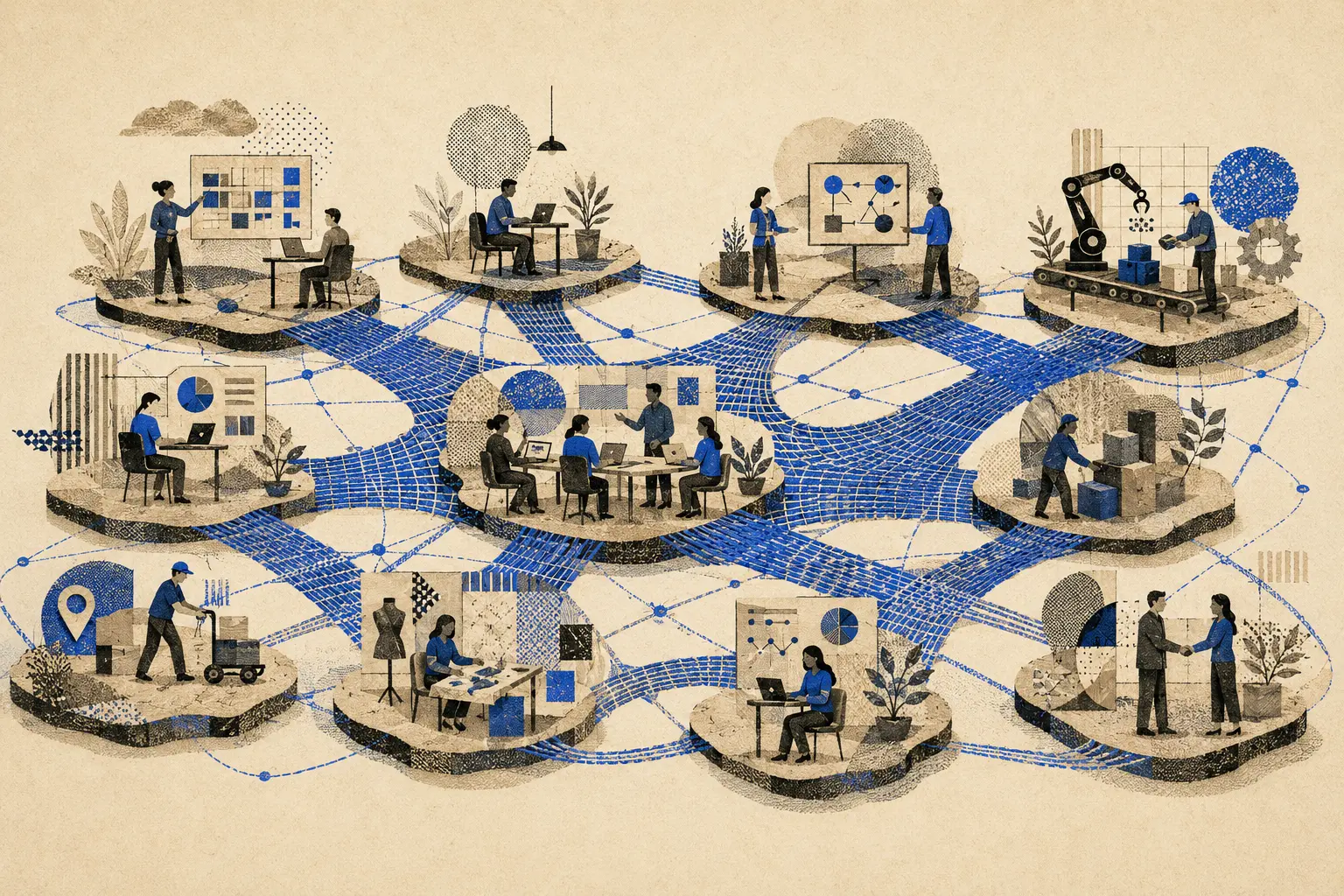
AI often enters a company through the side door. Marketing tries a content tool. Customer support tests a copilot. Technology operations connects a model to incident data. Risk builds a separate proof of concept. Each team is solving a genuine problem, and each project can show a quick result. The trouble appears when the company tries to move from a few demos to dependable daily work.
Fragmentation is easy to start.
Every pilot needs the same plumbing: identity, context, model access, tool permissions, memory, evaluation and audit. When departments build these separately, the enterprise ends up paying for the same work many times. It also gets five different answers to basic questions such as what an agent may do, where its data is stored and who is responsible when it is wrong.
The duplication is not limited to technology. One team defines a customer in one way; another uses a different record. Two assistants create their own memory about the same account. Model contracts and costs sit in different budgets. Security reviews start again for every new workflow. What looked like independence becomes friction.
A collection of clever assistants does not add up to an intelligent enterprise.
Company-wide does not mean one big project.
There is a reasonable fear that a company-wide strategy will become a two-year platform programme with no visible outcome. It should not. The right approach is to establish a thin shared foundation and prove it through a small number of valuable workflows.
The foundation should answer the questions every workflow shares:
- Where does enterprise context live, and how is it kept current?
- Which models can be used for which tasks and data classes?
- How do agents call tools and communicate with one another?
- Which actions are automatic, and which require a person?
- How are cost, quality, security and business outcomes measured?
Once these are common, business teams can still move independently. They simply do not have to rebuild the road before driving on it.
Shared context is where value compounds.
A support workflow may learn why a customer called. A risk workflow may know why a payment was stopped. An operations workflow may know which release caused a service issue. Kept in separate systems, these are isolated facts. Connected with the right permissions, they become useful enterprise context.
This does not mean every agent should see everything. Quite the opposite. A shared strategy makes access boundaries clearer. Context can be reused where permitted, restricted where necessary and audited in one consistent way. The company learns as a whole without creating an uncontrolled pool of information.
TechMojo Intelligence Fabric gives different teams one governed operating layer.
The Fabric connects enterprise context, agents, workflows, tools and models without forcing every department into one application. A shared Context Engine, agent communication, policy controls and a multi-model gateway provide the common foundation. Each function can then build for its own work while sovereignty, model choice, cost and audit remain consistent.
Explore TechMojo Intelligence Fabric →Begin with the work, not an AI catalogue.
A practical company strategy can begin in four steps. First, select two or three workflows with clear business value and owners. Second, identify the context and controls those workflows share. Third, form a small central platform team that provides standards and reusable components without becoming an approval queue. Fourth, measure actual outcomes—time saved, loss reduced, incidents avoided or customer effort removed.
This creates a useful balance. Teams see results early, while the enterprise avoids a fresh architecture for every experiment. Successful patterns become reusable services. Failed ideas remain small and inexpensive.
Local use cases, enterprise memory.
The best AI transformations are not centrally dictated, and they are not a free-for-all. They give business teams room to solve real problems on a foundation the company can trust.
That foundation matters because AI systems improve through context and feedback. If every department keeps its learning in a separate box, the company never becomes more intelligent—only more complicated. Start with a company-wide view, deliver through focused use cases and let each useful workflow make the next one easier.
This field note is part of TechMojo's series on production-grade enterprise intelligence.